Inside the World's Largest Solar Farm, Where 20,000 Sheep Keep the Grass Down
China's Talatan solar park grew so vast that the desert beneath it turned green. The fix for all that new grass was not a fleet of mowers. It was a flock.
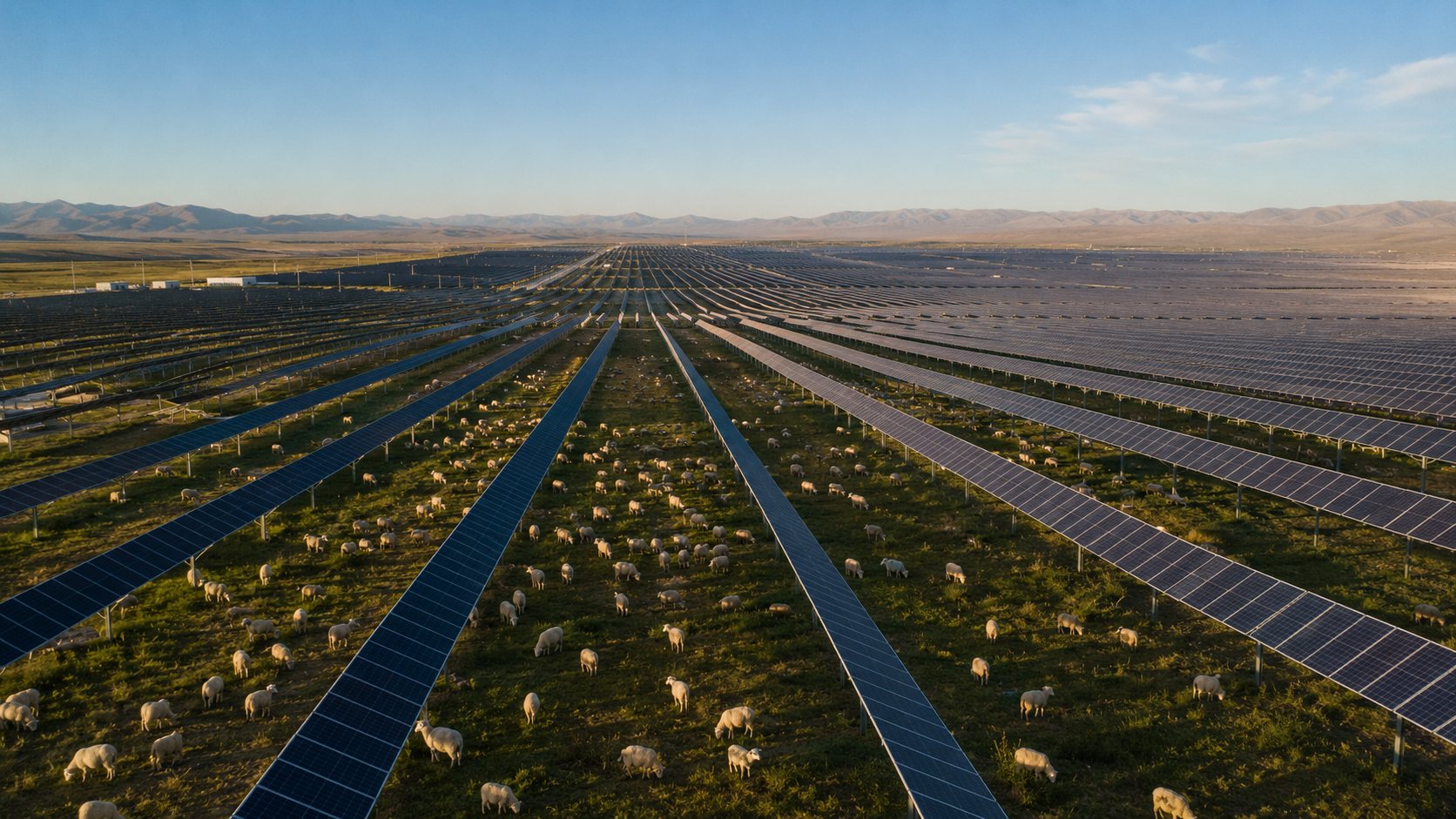
Sheep graze between the rows at a vast high-altitude solar farm. Illustration: Watts & Wild.
On a high plateau in Qinghai, in the northwest of China, sits one of the largest solar installations ever built. The Talatan park spreads across the desert in a grid so wide that it is visible from orbit, with millions of panels turning thin mountain sunlight into electricity for the national grid.
Then something unexpected happened on the ground. The desert started to come back to life.
How panels turned sand into pasture
Solar panels do more than catch sunlight. They cast shade, they cut the wind near the surface, and they slow down how fast water evaporates from the soil. Across a site this size, those small effects add up. The ground under and between the rows held on to more moisture, dust storms eased, and grass began to grow where there had mostly been sand.
That was good news for the land. It was a problem for the plant. Tall vegetation around solar rows is a fire risk, it can shade the lowest panels, and it makes maintenance harder. The operators needed to keep the new grass under control across thousands of hectares, and mowing a desert that big, machine by machine, is slow and expensive.
Enter the flock
The answer came from the local herders. Bring in sheep. Thousands of them now graze between the panels, trimming the grass for free, fertilizing the soil as they go, and turning a maintenance headache into a working pasture. Estimates put the flock around 20,000 animals, and the herders who tend them earn from grazing rights on land that used to grow almost nothing.
The nickname that stuck is simple and accurate. People call them photovoltaic sheep.
It is a neat loop. The panels make power and, as a side effect, make grass. The sheep eat the grass and keep the site clean. The herders earn a living, and the soil gets richer instead of blowing away. One piece of heavy energy infrastructure ended up doing the work of a farm.
A bigger idea than one solar farm
This is not a one-off curiosity. The mix of solar power and grazing has a name, agrivoltaics, and it is spreading. Around the world, sheep are now a common sight under solar arrays, because they are short enough to walk under the panels, calm around equipment, and cheaper than mechanical mowing. Some projects pair panels with crops instead of animals, using the partial shade to protect plants from harsh sun.
Talatan is the eye-catching example because of its sheer scale, but the lesson travels. Land does not have to be either an energy site or a natural one. Designed well, it can be both at once.
For now, the image is hard to beat. One of the most advanced energy projects on the planet, humming away in the thin air of the plateau, kept tidy by a method as old as farming itself.
Related reading: the world's largest battery will run on rust, and here is how iron-air storage works.